

Doing “all the things” but still not seeing the results? You’re about to find out why.
Stop Confusing Sweat With Strength
Why NYC Group Fitness Stops Working for Women Over 40
Boutique fitness classes are unmatched at giving you sweat, connection, and feel-good vibes. But if you are navigating perimenopause or menopause, chasing constant intensity often traps you in an illusion that accelerates biological aging while completely missing the one signal your body actually needs to thrive in midlife: heavy, progressive load.
In this article, you will learn:
The Hormonal Translation: Why declining estrogen means your body has stopped responding to random "sweat" and “burn” and now only speaks the language of structural "load".
The Investment vs. Expense Framework: How to stop draining your precious daily energy as a metabolic expense and start investing it for long-term health capital.
The 40+ Body Movement Hierarchy: The exact weekly training structure that balances lifting, cardio, and nervous system recovery without triggering hormonal burnout.
How to Actually Make Progress: Why you don't have to break up with your favorite group fitness crush…you just need to stop making them the foundation of your approach.
New York City women are extraordinarily good at effort.
You can see it any morning at 6:15 AM: the fleet of cabs pulling up outside boutique studios, the high-end activewear, the classes booked precisely three days in advance. Inside, there is a collective agreement to push: a dark room, a driving playlist, an instructor on a microphone, and the immediate validation of a heavy sweat.
To be absolutely clear, there is real value in that environment. A great group fitness class provides rhythm, community, accountability, and a powerful hit of morning euphoria before the rest of the city begins making demands on your time.
You do not need to break up with your favorite class. But you do need to stop making it the main character of your physical longevity.
For many high-achieving women over 40, group fitness becomes an accidental trap because it mimics the sensation of serious physical training while omitting the single most vital biological signal your body requires. Your body doesn't need more sweat, deeper exhaustion, or another random hard thing.
It needs progressive strength.
If your primary goal is simply to move, see friends, and enjoy the collective energy of a room, a studio class is a beautiful doorway. But if your goals include protecting bone density, driving muscle synthesis, optimizing a changing metabolism, and reclaiming your vitality after 40, group classes must transition to the supporting cast.
Strength training does not have to feel intimidating or dangerous; done safely and progressively, it is the most profoundly empowering way to build deep self-trust and realize exactly how strong you truly are.
Are Group Fitness Classes Enough After 40?
The short answer is usually no.
While boutique classes excel at creating temporary metabolic fatigue and emotional momentum, they are fundamentally not designed to deliver the mechanical overload, structured recovery, technical coaching, and repeatable tracking required to build real physical capacity.
The issue isn't that group fitness is bad; it's that many women are asking a group class to perform a biological job it was never engineered to do. It’s the biological equivalent of keeping your entire life savings in a checking account: it gives you immediate, satisfying liquid access to your energy, but it completely fails to compound or build long-term structural wealth.
Why Heavy Resistance Training is Crucial During Perimenopause and Menopause
The science isn't telling women over 40 to punish their bodies harder; it is telling them they need a cleaner training signal.
While public health guidelines recommend muscle-strengthening activities at least two days per week, this does not mean dropping into two random, high-impact classes where light weights happen to appear. True strength training requires a structured process that systematically maintains and improves muscular force.
Clinical research explicitly shows that targeted resistance training can be safe, highly effective vehicle for middle-aged and postmenopausal women to improve physical function, body composition, and lean muscle mass. This distinction matters critically because the menopausal transition brings profound shifts in bone mineral density, fat distribution, sleep quality, and cardiovascular risk.
To navigate these changes safely, your training must shift from a standard of effort and exhaustion to one of practice and mastery.
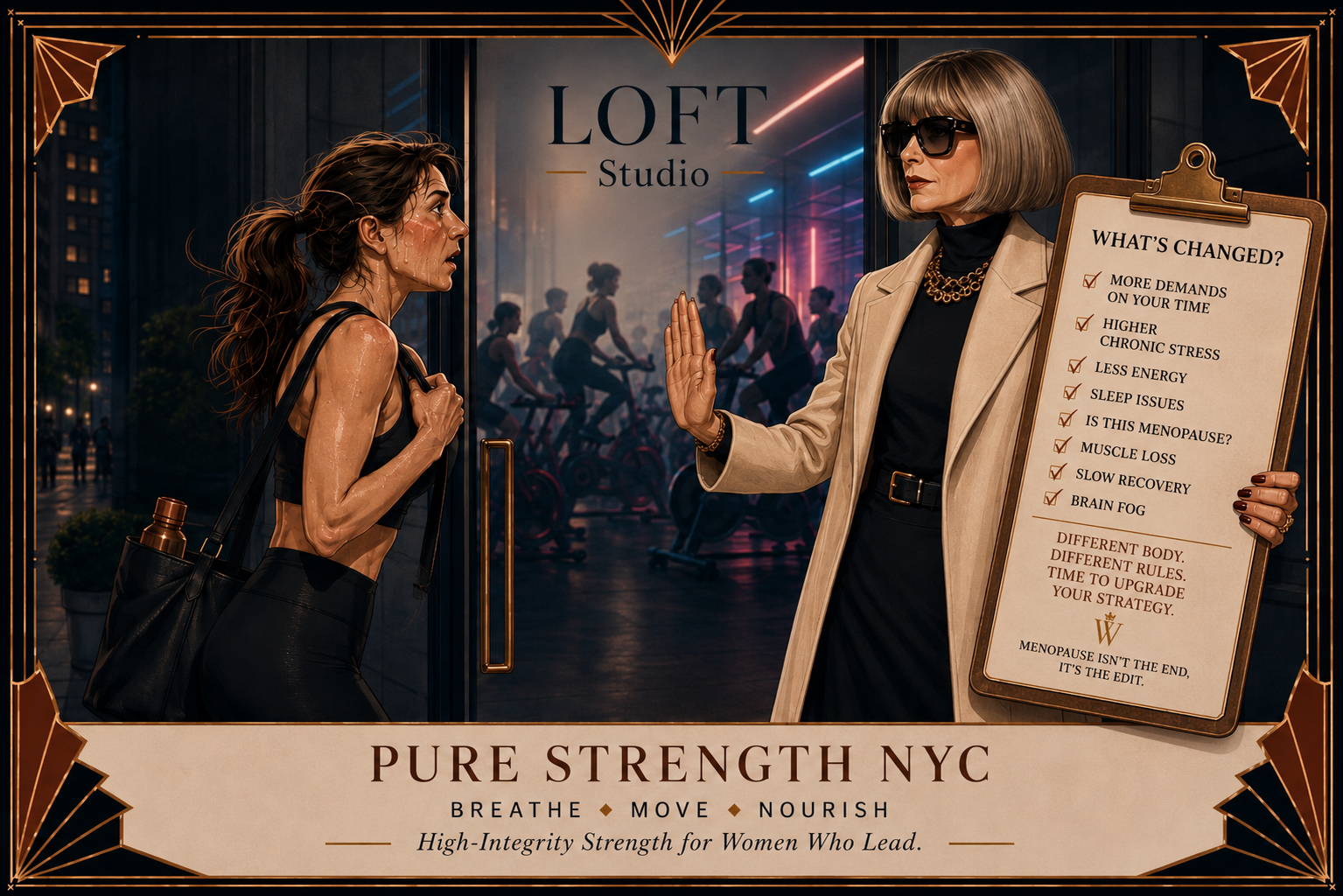
The rules of the game have changed. Your strategy needs to change too!
The Hormonal Translation: A Shift in Biological Language
To understand why your routine must change, look at perimenopause and menopause not as a physical breakdown, but as a total shift in your biological language. Your body used to comprehend the language of "sweat" and “burn”. But as you transition through your 40s, it stops listening to cardio and begins responding exclusively to the language of "Load."
This is a simple translation error, not a personal failure!
Here is the physiological reality that changes everything: As estrogen levels decline, your body experiences an abrupt drop in its primary natural anabolic (muscle-building) stimulus. This is exactly why you cannot out-cardio, out-sweat, or out-discipline your 40s. It’s like arriving at your favorite boutique hotel only to find they’ve upgraded all the locks to high-tech digital keypads—you can jam your old metal key into the door until you bust a nail, but it’s never going to open.
Because of this profound hormonal shift, your body now requires a much clearer, louder strength signal than it ever did in your 20s and 30s. Heavy external loading transitions from being a "nice option" to your primary, mandatory driver for maintaining bone mineral density, protecting your metabolic rate, and preserving skeletal muscle mass.
The practical takeaway is not complicated. Your body needs enough resistance to adapt, enough recovery to absorb the work, enough consistency to see a pattern, and progression over time. In plain English: your body needs a clear, undeniable reason to build. Sweat alone is no longer an adequate reason.
And group classes simply can not be designed to give you that signal. (More on that later).
Are You Expending Energy or Investing in Health?
Think of your physical output like a financial portfolio. Most group classes operate as a metabolic expense—you spend calories, you expend energy, you leak cortisol, and once the 45-minute timer hits zero, that capital is completely gone. You walked out with a temporary buzz, but your account balance is lower.
Real strength training functions as an investment.
Instead of draining your battery for a temporary metabolic burn, you are buying long-term physiological capital in the form of a dense bone matrix and functional muscle tissue. You aren't trying to burn yourself down to a smaller version of you; you are building a highly resilient, high-capacity machine that burns more fuel automatically, even when you're just sitting at your desk.
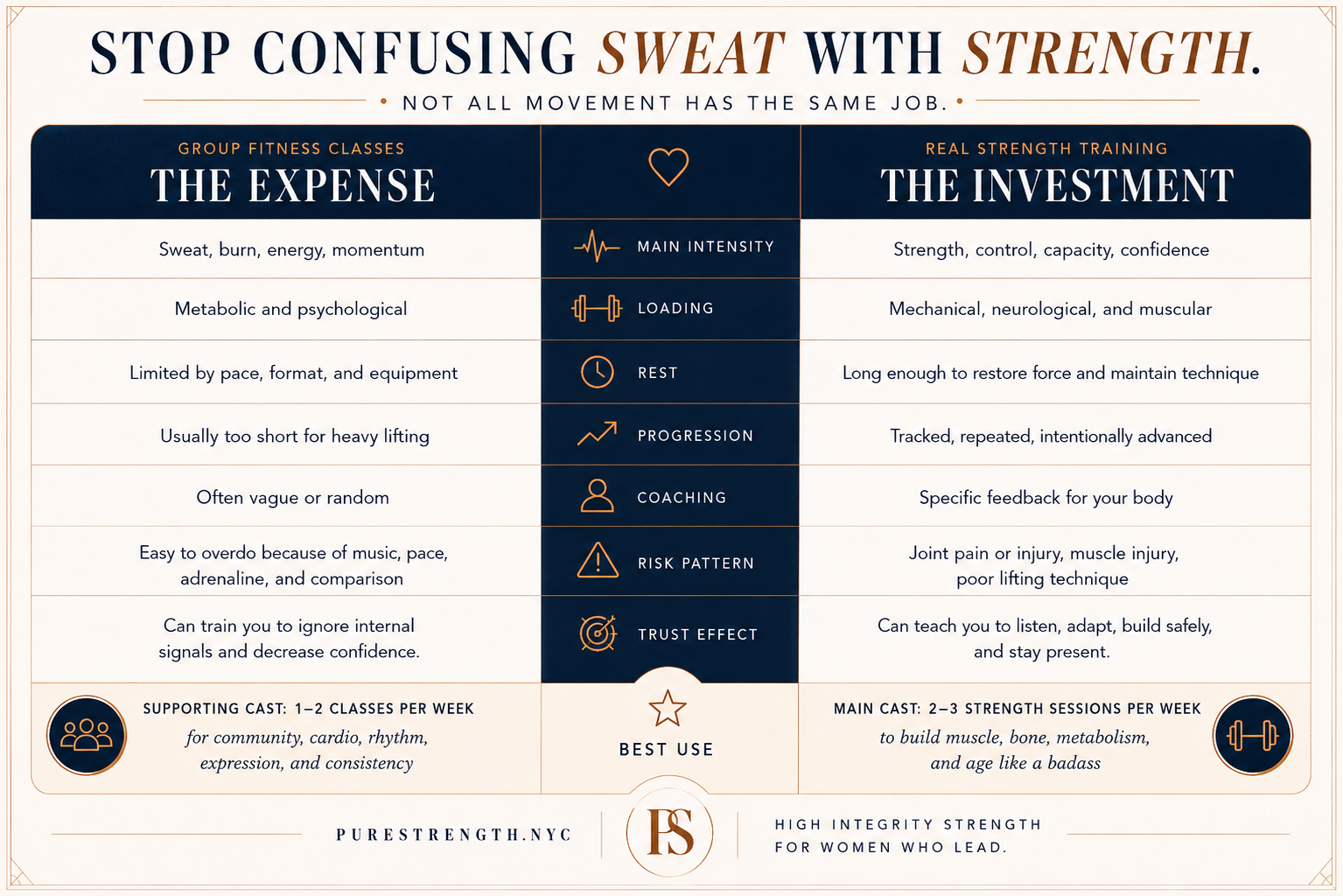
The right approach is balanced and diversified, and definitely doesn’t confuse an expense for an investment.
The Psychological Deconstruction
You are not just changing your workouts; you are rewriting decades of cultural conditioning.
This is the exact threshold most fitness advice completely skips. For many Gen X and elder millennial women, the foundational body-management software was installed very early, and it was deeply toxic: No pain, no gain. Count every calorie. Eat less, do more cardio. Sweat harder, get smaller. Control your body, ignore its signals, and push through.
That strategy may have appeared to work in your 20s and 30s. If your jeans got tight, you simply restricted your food, added another spin class, and got away with it. But let’s be honest: it was never a sustainable strategy. Your body was just young enough to survive it because your baseline hormones, sleep quality, recovery capacity, and life demands were entirely different.
Then, perimenopause walks into the room wearing excellent sunglasses and carrying a clipboard.
“Random 3:00 AM insomnia? Check. Unprovoked bloating and brain fog? Check. Mysterious lower back twinge from simply sleeping on a pillow wrong? Oh, absolutely. Let's see how that 45 minutes of burpees treats us today, shall we?”
Suddenly, the old playbook completely fails. You show up to the same high-intensity classes, but your body composition changes anyway, in the wrong direction! You work just as hard, but your daily energy plummets. You sweat more, feel less strong, and add extra cardio only to find your recovery is shot and your sleep is worse than ever. (Cue the mental health issue tsunami!)
You are not broken. Your body has simply outgrown a lie and can no longer cover up the dissonance between your psychology & physiology. Strength training is a great way to get these two aspect of yourself to meet and align.
But at first, shifting away from this conditioning can feel profoundly disorienting.
Slowing down feels like doing less. Resting for a full two minutes between sets feels suspicious. Tracking your weights feels tedious, and repeating the same movements can feel downright boring. Leaving the gym feeling energized rather than utterly destroyed can make you wonder if you even worked out at all.
The Intensity Illusion
One of the greatest flaws in modern group fitness is that the word “intensity” has been rendered almost meaningless. We’ve been conditioned to use it to describe anything that feels hard.
A boutique class can feel intense because the music is loud, your heart rate is spiking, the room is hot, the instructor is even hotter, and you never stop moving. But that is only one type of intensity. To build muscle, preserve bone density, and optimize your metabolism after 40, the vital element you are missing is mechanical intensity.
To understand why a workout can leave you drenched but unchanged, look at the four distinct forms of intensity:
Psychological Intensity: How hard the workout feels mentally and emotionally.
Metabolic Intensity: How hard your heart, lungs, and energy systems are pumping.
Mechanical Intensity: The amount of physical tension your muscle fibers must produce.
Neurological Intensity: How deeply your nervous system recruits, organizes, and coordinates force.
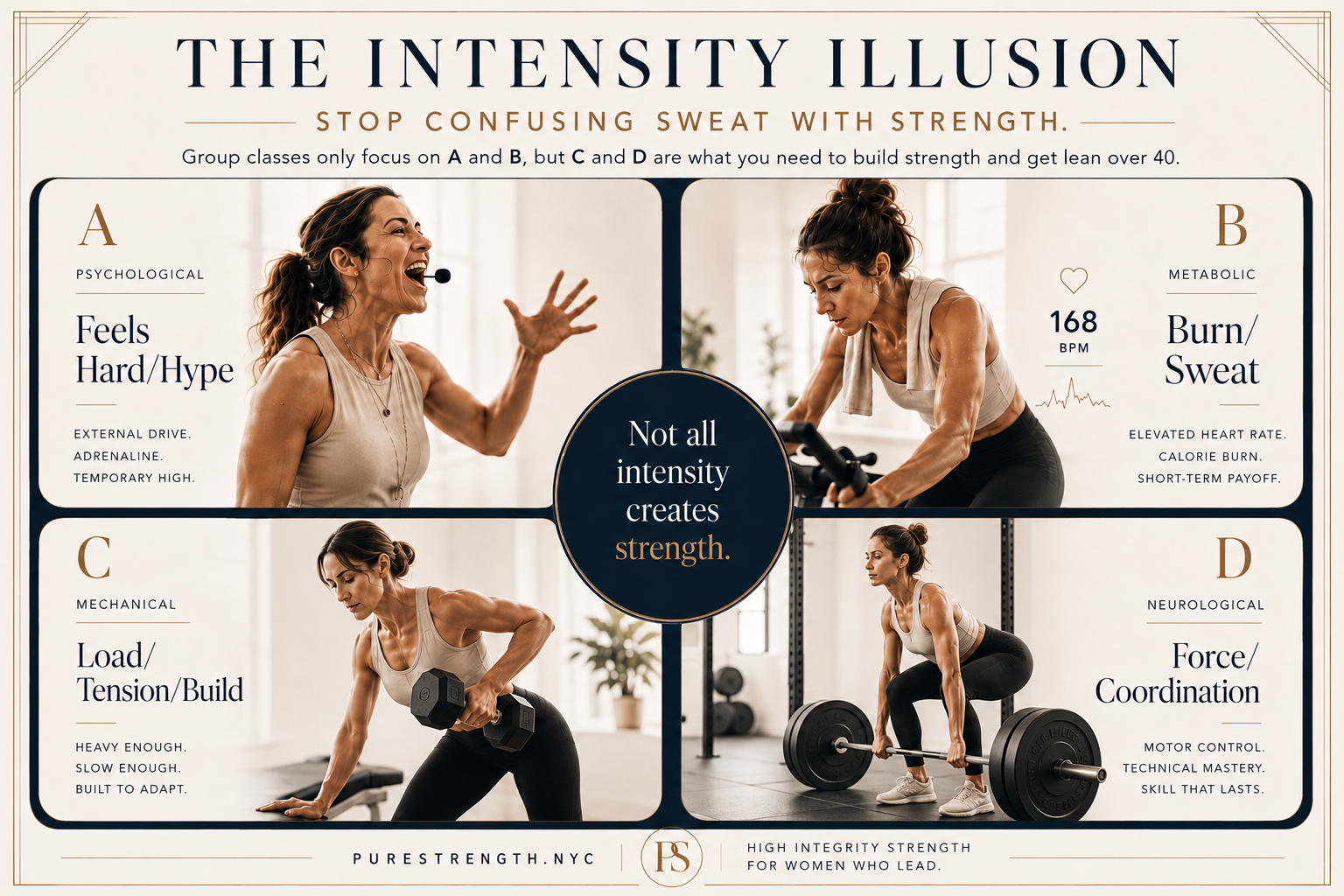
Intensity can feel productive while quietly keeping you stuck. Real progress comes from the right stimulus, not the loudest one. Don’t confuse activity for achievement.
Most group fitness classes are masterful at psychological and metabolic intensity. They are fundamentally incapable of delivering mechanical and neurological intensity. That is exactly why a class can feel brutal without making you structurally stronger. The experience leaves you temporarily drenched, but your body leaves without a single biological reason to build new muscle tissue.
The Risk Factor No One Talks About: The Room Overriding Your Body
There is another critical problem with group class culture that rarely gets discussed: it is dangerously easy to push too hard. Not because you are reckless, but because the entire environment is explicitly engineered to pull you completely out of your own internal signals.
The music is loud. The lights are low. The instructor is magnetic. The cute girl on the mat next to you is accelerating. Who does she think she is anyway! Your heart rate is up, your adrenaline is surging, and your endorphins are kicking in. Everyone is moving together, and some ancient reptilian part of your brain takes over and says: Keep up or die.
It can be a profoundly beautiful, meaningful experience. Our ancestors had to move together as one to survive! That tribal rhythm can feel amazing in the moment.
It can also make it nearly impossible to hear what your joints and tissues are actually trying to tell you. Pain becomes background noise. Fatigue becomes something to conquer. Endorphins (read: pain killers) are released and mask major joint issues. Compensation becomes essential. Your nervous system simply gets swept into the current of the room.
At first, this may just feel like a great workout. Over time, it manifests as chronic joint pain, creeping weight gain from chronically elevated cortisol, poor sleep, nagging aches, low baseline energy, irritability, and the frustrating feeling that you are working harder than ever while getting less back… because (drum roll, please…) you are!
This is exactly why group classes become risky for women over 40 who are trying to build strength safely. Strength training has risks, too, of course. You can lift too much too soon, use poor technique, or let ego choose the weight.
But when strength training is done well, the very structure of the session dramatically reduces that risk. You slow down. You rest. You repeat the exact same movements. You actively notice what your joints are saying. You adjust the load dynamically. You track exactly what happened. You build capacity gradually.
That is not just safer training; it is a completely different relationship to your body. Group classes teach you to keep up; real strength training teaches you to listen, adapt, and build.
Do not confuse the energy of the room with the wisdom of your body.
The Deeper Trap: Using Class to Escape Your Body
Many brilliant women remain fiercely attached to group classes because those environments solve a very real, very exhausting emotional problem: they completely remove the burden of decision.
Think about what you get to leave at the door. You don’t have to figure out what exercise comes next. You don’t have to know how much weight to load onto a barbell. You don’t have to track data, log sets, or brave the subtle, gatekeeping intimidation of the traditional weight room, nor deal with the bros checking you out.
Best of all, you don’t have to slow down long enough to hear what your body is actually saying to you. You just buy the credits, put on the cute outfit, clip into the bike or step onto the mat, and follow the leader.
At the tail end of a high-stress NYC day where you’ve made a thousand critical decisions for everyone else, that abdication of control is a massive relief. But over time, it quietly morphs into a mechanism for avoiding true physical ownership.
This is where the pattern gets insidious, and this is not an understatement.
Most ambitious women have spent their entire lives being systematically trained by corporate expectations, beauty standards, diet culture, and the heavy demands of family or motherhood to override their own personal boundaries.
We’ve all downloaded the same cultural malware: Ignore your hunger. Mute your exhaustion. Dismiss your resentment. Disregard your need for quiet space. Push past the ache. We ignore the truth our bodies are whispering until they are forced to start shouting.
And then, we walk straight into a premium boutique studio and practice that exact same self-betrayal under much better lighting. Push harder. Keep pace with the person next to you. Whatever you do, do not slow down.
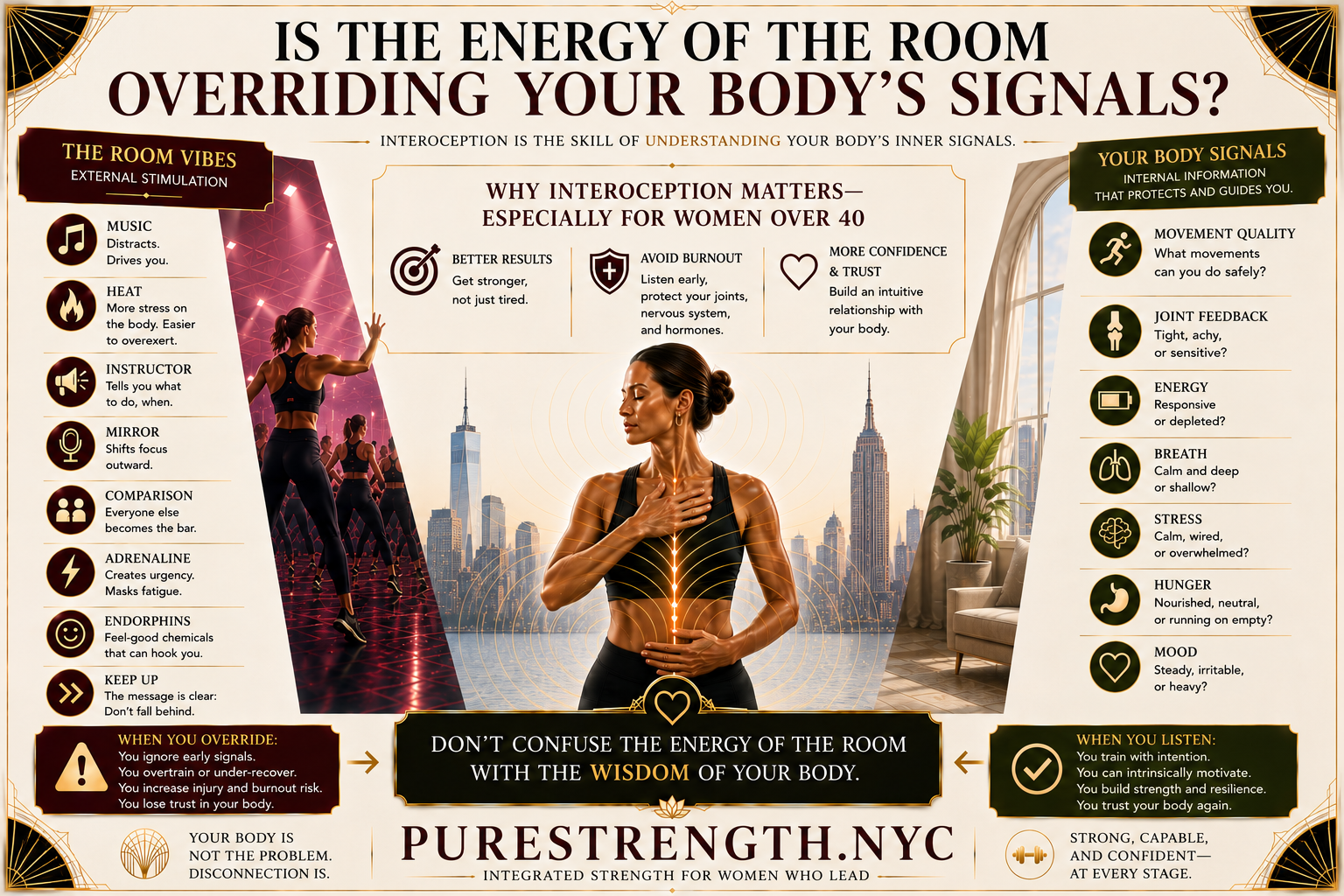
Listening to your body is a skill, one that’s impossible to learn when over-stimulated & forced to perform for an audience.
True Story: Unlearning Self-Betrayal
I once coached a client who moved through her squats the way many high-achievers move through a packed fitness class: fast, automatic, and profoundly disconnected—like she was trying to escape her own skin as quickly as possible. She was undeniably strong. She was incredibly capable.
But she was rushing entirely past the place where the actual medicine was.
I paused her and asked for a shift: “Slow down. Feel your heels against the floor. Feel your legs supporting you. Feel the actual muscles working for you. Stop trying to run away from the sensation—feel the power you are actively building right now.”
That distinction changes everything. True strength training is not merely a sequence of muscular contractions; it is a profound practice of deep attention. It is the ultimate training ground for teaching yourself how to stay with your body under pressure. You learn how to not collapse, how to not override your limits, and how to not dissociate into the driving bassline of a speaker system.
And this ability to practice deep attention when thing are uncomfortable - to not let the anxiety over-ride you, nor escape/dissassociate from your experience - is a weight room skill that translates to all areas of life.
That exact same student later shared something incredible with me. A few weeks after shifting her training, she was able to skillfully deny the unwanted advances of a co-worker. Without playing coy, freezing up, or being rude, she just stood her ground and spoke her boundary clearly… for the 1st time in her life!
I witness this precise phenomenon with my clients all the time. The deeply practiced ability to tolerate and stay fully present with physical discomfort in the weight room translates directly into the ability to do the exact same thing with emotional discomfort out in the real world. When you stop running away from physical tension and stop trying to escape your body, you can begin to develop an unbreakable brand of real-world confidence that is arguably more powerful than any physical change to the body (although the two usually go together!)
Also, Don’t Confuse “the Burn” With Strength Either
When we understand that real strength training is an active practice of presence while systematically lifting heavier weights, it becomes obvious why so many trendy "strength" and specialized "glute" classes are structurally misleading. They feature weights, resistance bands, and high-status marketing terminology—so to the untrained eye, it looks exactly like true resistance training.
But holding a weight does not automatically mean you are building strength. Just as we must stop confusing sweat with strength, we must also stop confusing the burn with strength.
If you do not have one to two minutes of real, passive rest between hard sets, your nervous system cannot regenerate the cellular fuel required to lift your heaviest useful loads. Without that heavy mechanical tension, you completely fail to recruit the deeper, high-threshold muscle fibers that trigger real strength, protect bone density, and stimulate vital hormonal adaptation.
I call this the “strength class” lie.
Instead of going deep into the tissue to create lasting structural change, fast-paced group “strength” classes end up just skimming the surface. The tempo is too fast, the rest is too short, and the weights are fundamentally restricted by whatever light dumbbell you can hold for a high-rep time block. You aren't doing progressive strength training; you are doing weighted cardio or metabolic conditioning. While conditioning absolutely has its place, it will not trigger the deep muscular and skeletal adaptations your body requires during the menopausal transition.
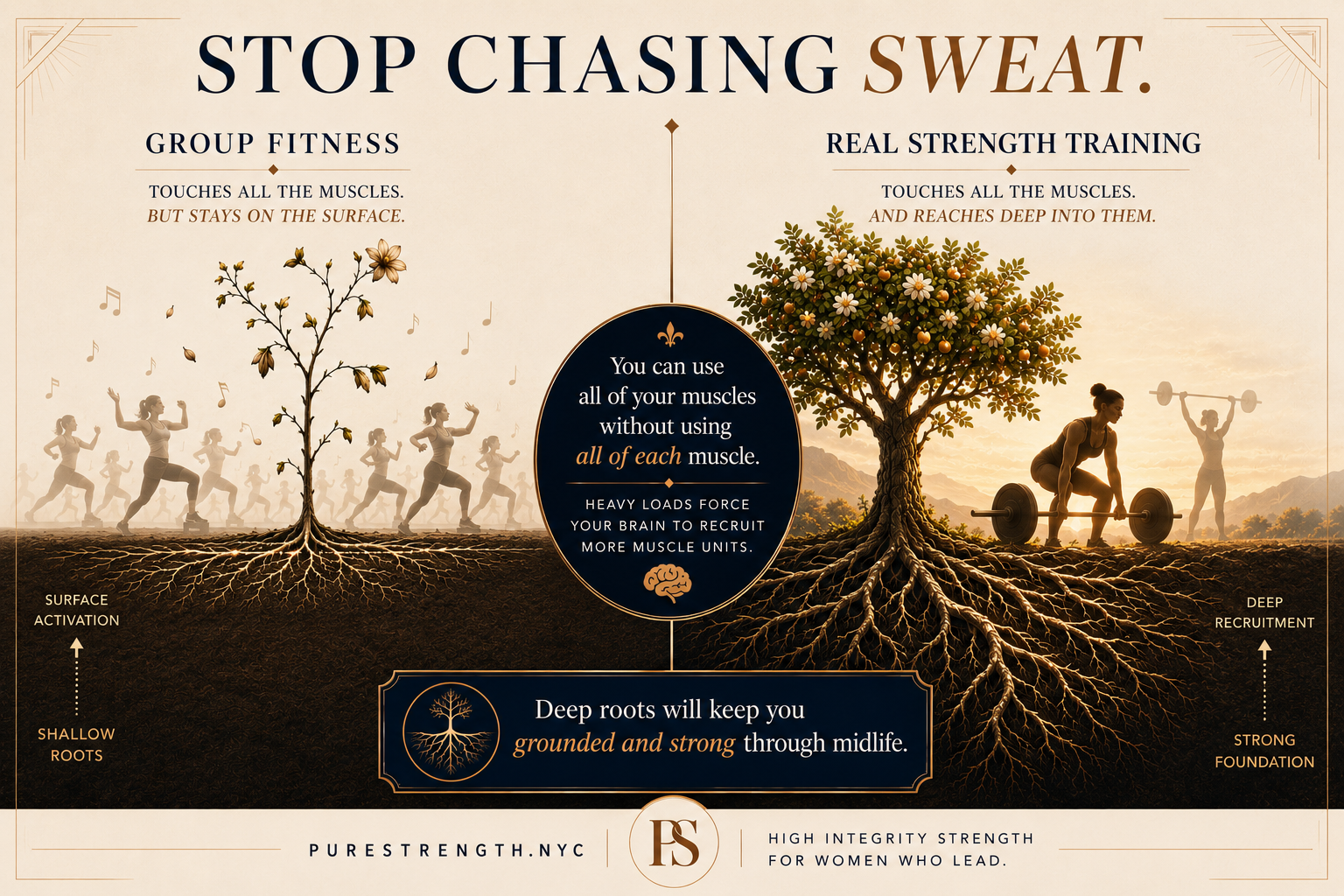
Group fitness provides a surface-level neurological "flush" (sweat and endorphins), while structured progressive loading anchors deep, permanent neural signaling—the exact foundation your metabolism and nervous system need to thrive after 40.…. so you can age like a baddie!
Most of these formats are not muscle-building classes; they are muscle-feeling classes.
Take the popular glute-focused sessions: they create an incredible lactic acid burn that makes the subway stairs feel hostile the next day. But the burn is not the same thing as the build. Your glutes are massive, powerful muscles designed to produce explosive force against meaningful resistance over brief intervals, followed by deliberate rest.
Imagine What A True Group Strength Class Would Look Like!
The instructor walks into a premium boutique class in the Flatiron District of NYC and says:
“Welcome, everyone. Today, we are doing heavy hip thrusts and split squats. You will work very hard for 20 to 40 seconds. Then you will rest completely for two full minutes. During that rest, I will continue shouting inspirational things into the microphone while you do absolutely nothing. Please do not pulse. Do not add a random plank. We are waiting because your nervous system needs to recover so you can produce maximum force again. That force is the entire point.”
Everyone would be completely confused.
Half the room would feel like they weren’t working hard enough, and someone would inevitably wonder why they paid a premium drop-in fee just to sit on a bench. Because the boutique studio business model cannot support the physical infrastructure—heavy barbells, squat racks, long rest windows, and individualized technical coaching—the format forces an exchange of heavy mechanical load for fast-paced, unweighted novelty.
Progress is built through deep repetition with high awareness, not through the dopamine confetti of a brand-new random circuit every day!
What Women Over 40 Actually Need
Most high-achieving women over 40 need exactly two to three full-body strength training sessions per week.
Not punishment sessions. Not random circuits. And definitely not endless tiny pulses while pretending five-pound dumbbells are a valid personality trait. Real strength sessions.
To get started, 25 to 35 minutes is more than enough when the work is highly focused. A premium, high-integrity session should prioritize compound movements that hit multiple joints at once—sorry, no bicep curls if you’re trying to get maximum cellular return in 30 minutes.
It could include an authentic squat or lunge pattern, a hinge pattern, a push, a pull, and a carry or core-stability element. It requires enough load to force your biology to adapt, enough rest to repeat high-quality work, enough tracking to know whether you are progressing, and enough nervous system awareness to know when to build, when to back off, and when to restore.
But here is the part the fancy Equinox instructors don’t want you to hear: strength training is a skill.
That is precisely why group classes are so incredibly seductive. They are entirely done-for-you. You outsource the thinking, the pacing, the structural programming, and the baseline motivation to a trainer with a headset. Real strength asks significantly more of you at first. You have to learn. You have to pay attention. You have to build real, internal confidence with your mechanics. You have to stop measuring the absolute value of a workout by how utterly wrecked you feel afterward.
Frankly, proper strength training is more like learning to play a musical instrument than a group fitness class! Skill acquisition takes patient practice, focus, curiosity and repetition…. but just think of the beautiful music you’ll make with your body!
Because once you master the skill, everything changes. You are no longer dependent on the energy of a room or a playlist that slaps. You finally know exactly what your body needs—and you can give it that stimulus independently, anywhere in the world.
This is not about becoming a powerlifter. It is about becoming a woman who can fully trust her own power in any situation. And in order to do that, you need progressive overload!
What is progressive overload for women over 40?
Progressive overload is the systematic, gradual increase of stress placed on the body’s musculoskeletal system during resistance training. Instead of shocking your body with a random assortment of high-impact exercises every Tuesday morning, it means tracking a specific movement—like a squat or a chest press—and intentionally increasing the weight, the repetitions, or perfecting the tempo over a period of weeks.
For women over 40 navigating perimenopause and menopause, progressive overload is not about lifting to exhaustion or trying to become a bodybuilder; it is the single most precise biological signal you can send to your body. As estrogen levels naturally decline, your bones and muscles lose their primary chemical protector. Progressive mechanical load forces your nervous system to trigger muscle protein synthesis and stimulates bones to remodel and densify. Without this structured, measurable progression, your body cannot adapt, leaving you trapped in a cycle of constant sweat without building long-term physical capital.
You Do Not Need to Break Up with Your Class
If you truly love your class, keep it. The goal here is not to become a joyless technician wandering around a weight room with a clipboard and a dead stare.
Keep the dance class. Keep the high-end Pilates reformer session. Keep the class where the music makes you feel twenty-seven and temporarily free from the tyranny of your inbox. Just stop asking that class to do a physiological job; it was never engineered to do so.
Use classes for joy, rhythm, personal expression, metabolic conditioning, and community. Use progressive strength training to build the architectural framework that will carry you beautifully through the next thirty years of your life. That is the vital distinction, and a grown-up strategy.
The Solution: Where Do Fun NYC Group Classes Belong?
Group classes can absolutely belong in a smart, high-status training life. They can be your joy, your cardio, your community, your release valve, your dance floor, and your premium space to move with other people instead of living entirely inside your own head.
But they should not replace strength training if your goals include building muscle, preserving bone density, optimizing body composition, increasing functional strength, and feeling truly powerful in your midlife body.
The Movement Hierarchy of the 40+ Body
To organize your routine with the least amount of wasted effort and the highest biological return, structure your week around this elegant hierarchy:
The Main Character (2–3 Sessions/Week): Full-body progressive strength training. This is your primary, non-negotiable driver for thriving in midlife. There’s just too much science backing this up as the primary lever for thriving in midlife.
The Supporting Cast (1–2 Sessions/Week): Your favorite boutique group classes are used intentionally for pure joy, cardiovascular conditioning, rhythm, or community.
The Stage Crew (Daily/As Needed): Explicit recovery and nervous system regulation. Walking, mobility work, intentional breathwork, restorative practices, or Qigong to drive down cortisol and support deep sleep.
Strength training is the A-list celebrity. Group classes are the supporting cast. Recovery is the stage crew. Your internal awareness is the director. And your body and life is the stage where it all comes together.
With everyone playing their appropriate role, you can live the most epic, beautiful performance of your life.
Keepin’ It Real: Facing the "Class-Addict" Anxiety
When you realize the old fitness software is crashing, a very real wave of anxiety tends to move in. For years, boutique class culture has been your identity, your stress release, and your social anchor. Walking away from that—even a little bit—can feel terrifying.
You might worry about losing your community, dropping the consistency you fought so hard to establish, or letting down your favorite instructors. Worst of all is the deep-seated guilt of slowing down. When you’ve been conditioned to believe that a workout only counts if you leave in a literal puddle of sweat, resting between sets feels highly suspicious—almost like cheating. It triggers a persistent, anxious loop: Am I doing enough? If I don’t destroy myself today, will I slide backward?
And the, when that time of the month decides to show up, all that insecurity gets magnified by the bloating and disorientation that is created when you avoid the impulse to just “sweat it out”, so you feel a little sense of control. At least like you did something, right?!
Let's lower the pressure right now: You do not have to give up all your classes at once. In fact, you shouldn’t give them up at all. Just stop asking them to do a job they were never designed to do.
This isn't an ultimatum or a messy breakup. It's an elegant rebalancing. If a specific spin or Pilates class brings you genuine joy and connects you to your friends, keep it in your calendar. The goal is simply to shift it from the lead role to the supporting cast. By anchoring your week with two dedicated strength days, you give your body the heavy mechanical load it is starving for, which actually unlocks the freedom to enjoy your favorite classes without asking them to fix your metabolism or save your bone density.
You are adding foundation, not subtracting joy! Just remember that progressive overload is the priority—if you start to notice your class schedule is preventing you from recovering fully for your strength days, it’s simply time to pump the brakes.
Surviving the "Sweat-Metric" Withdrawal
This transitional phase is a high-anxiety period. To quiet that nagging “did I do enough?” voice, you have to establish a brand-new metric for what a "win" looks like:
The Old Win: A red-lined heart rate, a puddle on the mat, legs shaking, buns burning, and the satisfying validation of being completely wiped out.
The New Win: Successfully lifting a heavier load than last week, slowing down to improve your form—all while staying present in your body without checking out or quitting due to "boredom."
This new type of success provides a deeply satisfying reward: the joy of mastery over exhaustion. Navigating the anxiety of slowing down is simply the necessary withdrawal period from a fitness culture that taught you to measure your biological worth exclusively in sweat/burn.

You’re actually already stronger than you realize, it’s just a matter of unlocking it. Every great adventure deserves a trusted guide. Nothing brings me more joy than helping women discover their true strength and witnessing the deep self-trust that it creates.
The Pure Strength NYC Bridge: Built for Autonomy
When many women finally accept that they need heavy external loading to thrive in perimenopause, they encounter a massive second barrier: the environment.
The alternative to a boutique studio often feels like a commercial big-box gym. Traditional weight rooms can be rough—frequently loud, hyper-masculine, mirrors-everywhere environments dominated by ego lifting and an undercurrent of subtle judgment. For a busy professional or a mom who has so much riding on her every single day, walking into that territory without a plan is an energetic drain you simply do not have time for.
You don’t need another dark room to hide away in. Nor do you need another bright stage to “perform” wellness.
You need a bridge.
Instead of a high-pressure, "no pain, no gain" corporate culture, you deserve an elegant, wholesome approach designed specifically for the needs of the modern, urban woman.
With practice, you can learn the skills and body literacy required to walk into absolutely any gym in the world—or use no equipment at all—and know precisely how hard to push, what your body needs, and how to adapt your training based on how you feel each day.
Your Path Forward: Simple, Customized, and Sustainable
Learning a brand-new way of moving, lifting, and relating to your body can easily trigger intense decision fatigue. When your calendar and mind are already maxed out, you don't need a complex spreadsheet—you just need the process broken down into simple, actionable chunks.
You do not have to figure it out alone. Don't guess your weights, gamble with your joint safety, or force yourself into an environment that makes you defensive.
We have built a customized, high-touch onboarding experience designed to meet you exactly where you are. By combining premium in-person coaching with our own custom training app, we give you the clear structural guidelines to master baseline movements at your own pace while building the long-term independence your lifestyle demands. We help you quiet the noise of old conditioning, respect your unique female physiology, and make learning how to lift safely as simple as possible.
Stop worrying about which group class you should do next and start asking a way more powerful question: Are you ready to stop chasing sweat and start building the strength that will allow you to age like a bad ass?
Imagine feeling strong in your body again, clear in your mind, and confident that your workouts are actually moving you forward.
The first step is simple: book a 15 minute clarity call using the button below. On it we’ll look at where you are, what has changed, and what your body needs now.
This is where the next chapter starts: more strength, more energy, more trust in your body. Not by doing everything harder, but by making it as simple as possible to do the right thing.
Your body is asking for respect, load, and intelligent recovery. Let’s build it together.
Your Coach,
Jonathan